My tool showed a VAT credit almost 7 times too big.What an accountant taught me
A VAT credit almost seven times too big, missing revenue, and the decision not to show an income-tax estimate. What I learned building a tool for accountants.

In this article· 5 sections
In a tax tool, the most important feature is invisible: getting the numbers right. A beautiful chart with the wrong amount is worse than no chart at all. For Forologika that meant checking every calculation against real data, together with an accountant.
The credit that didn’t exist
VAT looks like simple subtraction: output VAT minus input VAT. The hard part is the credit balance carried over from period to period.
On a real test account, Forologika showed a credit almost seven times larger than the one the accountant had filed. The app had been carrying forward credit from very old periods, credit that had already been offset or no longer applied.
The fix had two parts. The credit chain is now capped at 12 months, so old balances can’t inflate the result. And users can enter the credit from the return they actually filed: if the accountant knows the right amount, the app respects it.
The missing revenue
A second problem was sneakier. For some businesses, revenue in myDATA was incomplete, because not every document was transmitted the same way, so it showed up far lower than it really was.
The answer was to cross-check sources: where VAT turnover is confirmed by another source and is higher than the incomplete revenue, that figure is used. After the fix, every stored month was fetched again from scratch, so no user was left with old, wrong numbers.
How close does the year’s result get?
In October 2026 I added the “Result” tab, which estimates the year’s accounting result from myDATA’s E3 classifications. It covers depreciation, inventory, payroll and cash-register sales. Before showing it to users, I checked it against an accountant’s figures:
| Case | Difference from the accountant |
|---|---|
| Business with a closed previous year | 1–3% |
| First year with fixed assets | 7–15% lower |
There’s a reason for the second case: in the first year there’s no history for depreciation. So the app tells the user plainly, instead of showing a number with false confidence.
Why there’s no income-tax estimate
One requested feature was an income-tax estimate on the dashboard. I decided not to add it. The estimate could be tens of thousands of euros off and contradict what the accountant tells their client.
A tool that works with the accountant, not against them, has to know where to stop.
When I’m not sure, I say so
Numbers get checked with a professional, not by instinct, and an accountant is the best test there is. When a calculation is fixed, the past has to be fixed with it; that’s why every stored month was fetched again. And an honest “I’m not sure here” beats a nice-looking wrong number.
Forologika is live at forologika.net with a 15-day free trial, for businesses and accountants.
Found it useful? Share it
Keep reading
- e-EFKA has no API. So I built a robot that reads ite-EFKA has no public API for social security contributions. How I built automation that reads it safely, what broke along the way, and how I fixed it.
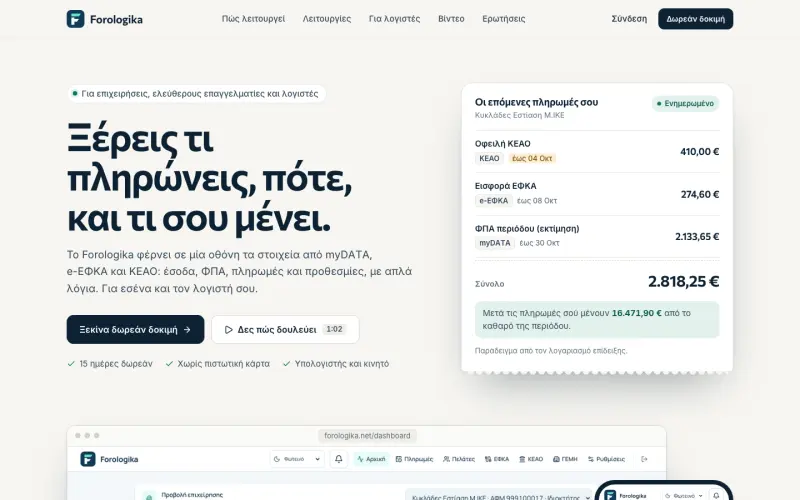
- Tired of logging into myDATA, e-EFKA and KEAO? I put them on one screenHow Forologika was built: a myDATA connection, automation where no API exists, VAT estimates and alerts before every deadline.
The project behind this article
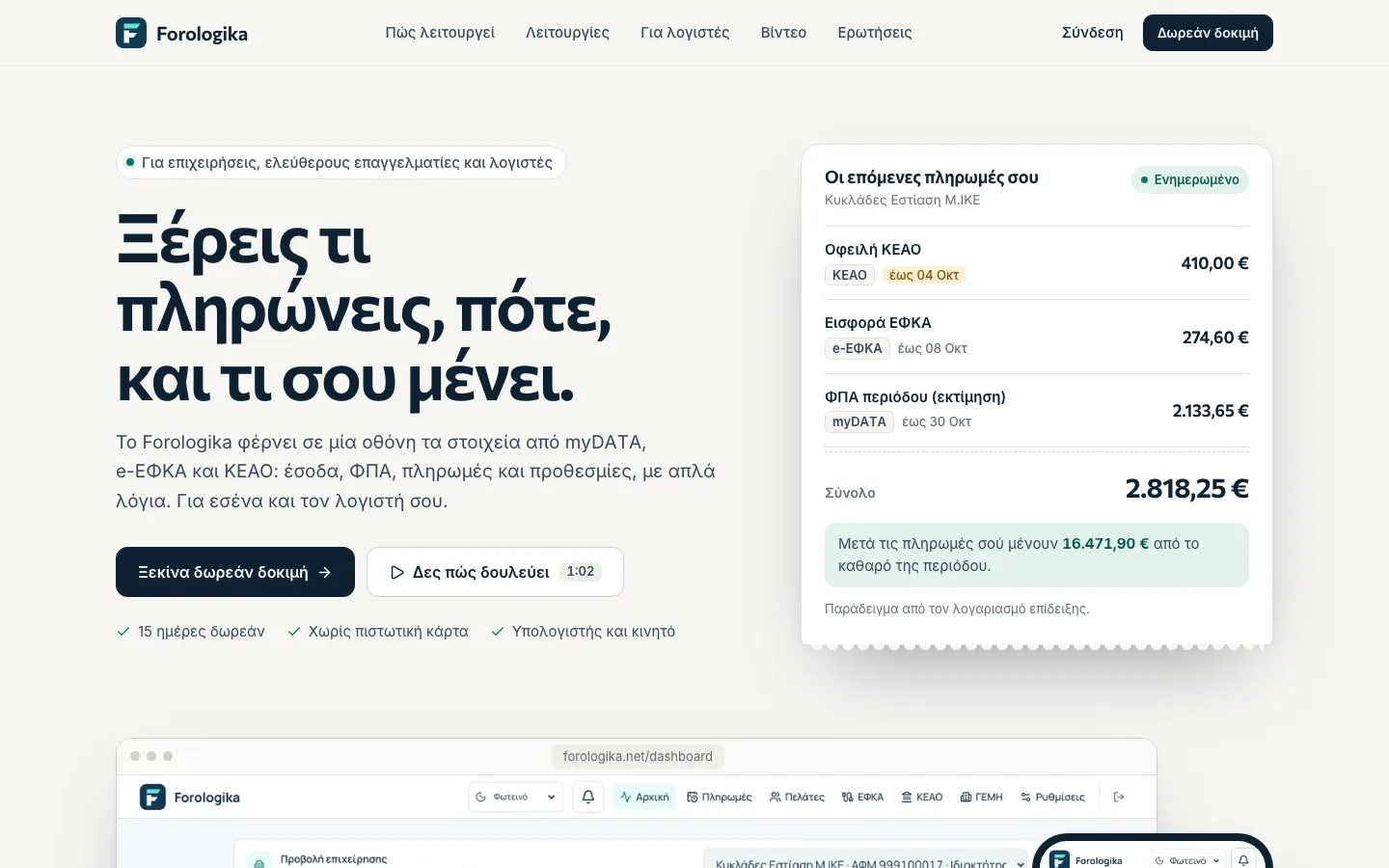
A business’s tax and social security obligations on one screen: myDATA, VAT, e‑EFKA and KEAO.