Tired of logging into myDATA, e-EFKA and KEAO?I put them on one screen
How Forologika was built: a myDATA connection, automation where no API exists, VAT estimates and alerts before every deadline.

In this article· 6 sections
Every freelancer in Greece knows the routine: log in to myDATA for revenue and expenses, e-EFKA for social security contributions, KEAO for debts, and somewhere in between try to remember when VAT is due. Three platforms, three logins, a VAT deadline on top, and no overall picture.
Forologika started from one simple question (what do I owe, when, and what’s left for me?) and the need to answer it on a single screen.
Only one of the three has an API
It would be easy if every government service had a modern, unified API. They don’t. AADE’s myDATA has an official API for revenue and expenses, so that connection is clean and stable. e-EFKA and KEAO offer no equivalent public API for this data, which leaves controlled automation that reads the pages the way a user would.
That made the first decision an architectural one: the automation does not run inside the website. It runs in a separate worker (Playwright on a Hetzner server), on its own schedule, with retries. Government platforms are often slow or down, and when they are, the app keeps working normally.
How the data reaches one screen
- myDATA, e‑EFKA, KEAOThree government platforms, three logins
- ForologikamyDATA through its official API; e‑EFKA and KEAO through a separate automation worker
- One screenWhat do I owe, when, and what’s left for me?
The Guard checks so users don’t have to
Nobody wants to remember to check. The Guard is a service that looks for changes periodically and sends a push or email alert when something needs attention: a new debt, an approaching deadline, an amount that changed.
Every check is written to an audit trail. With taxes, you always need to be able to answer “when did we see this, and what did it say?”
VAT is not simple subtraction
A VAT estimate sounds simple: output tax minus input tax. Then there’s the credit balance carried over from period to period, and that is where most mistakes happen.
Before the app went live, the logic was checked against a real accountant’s figures, period by period, until the numbers matched. In a tax tool, verified numbers are what earn trust.
One accountant, dozens of businesses
Accountants don’t look after one business; they look after dozens. Forologika supports multiple entities per account and accountant access by invitation: a business invites its accountant, who sees only what they’re allowed to.
That kind of security can’t depend on a developer remembering every check. So the database (Supabase/PostgreSQL) uses Row Level Security, which keeps the access rules inside the database itself. Even if there is a bug in the code, one account cannot see another’s data.
What it runs on
| Layer | What it uses |
|---|---|
| Screen | Next.js, installable app (PWA), Web Push |
| Application | Supabase PostgreSQL with Row Level Security, myDATA connection |
| Cloud | Cloudflare Workers with KV cache, automation worker on Hetzner |
| Protection | Cloudflare Turnstile against bots |
When the platforms go down, the app stays up
Government platforms will be slow, and sometimes they’ll go down; the app shouldn’t go down with them. Security belongs in the database as well as the code, because Row Level Security catches the mistakes that will happen eventually. And before I trust a tax calculation, an accountant checks the numbers.
Need a tool that connects to myDATA or to systems you already use? The first conversation is free.
Found it useful? Share it
Keep reading
- e-EFKA has no API. So I built a robot that reads ite-EFKA has no public API for social security contributions. How I built automation that reads it safely, what broke along the way, and how I fixed it.
- My tool showed a VAT credit almost 7 times too big. What an accountant taught meA VAT credit almost seven times too big, missing revenue, and the decision not to show an income-tax estimate. What I learned building a tool for accountants.
The project behind this article
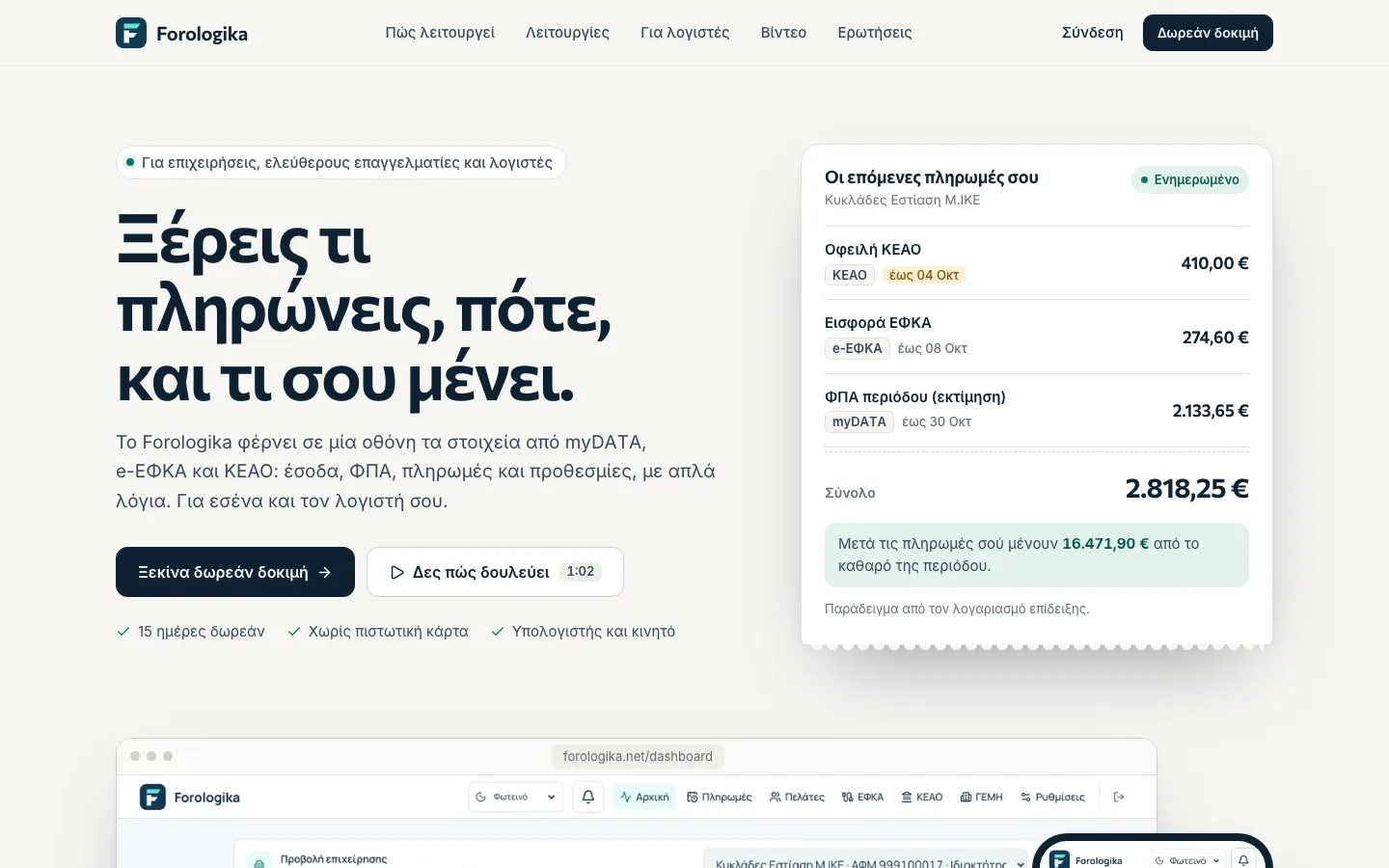
A business’s tax and social security obligations on one screen: myDATA, VAT, e‑EFKA and KEAO.