DeepStack
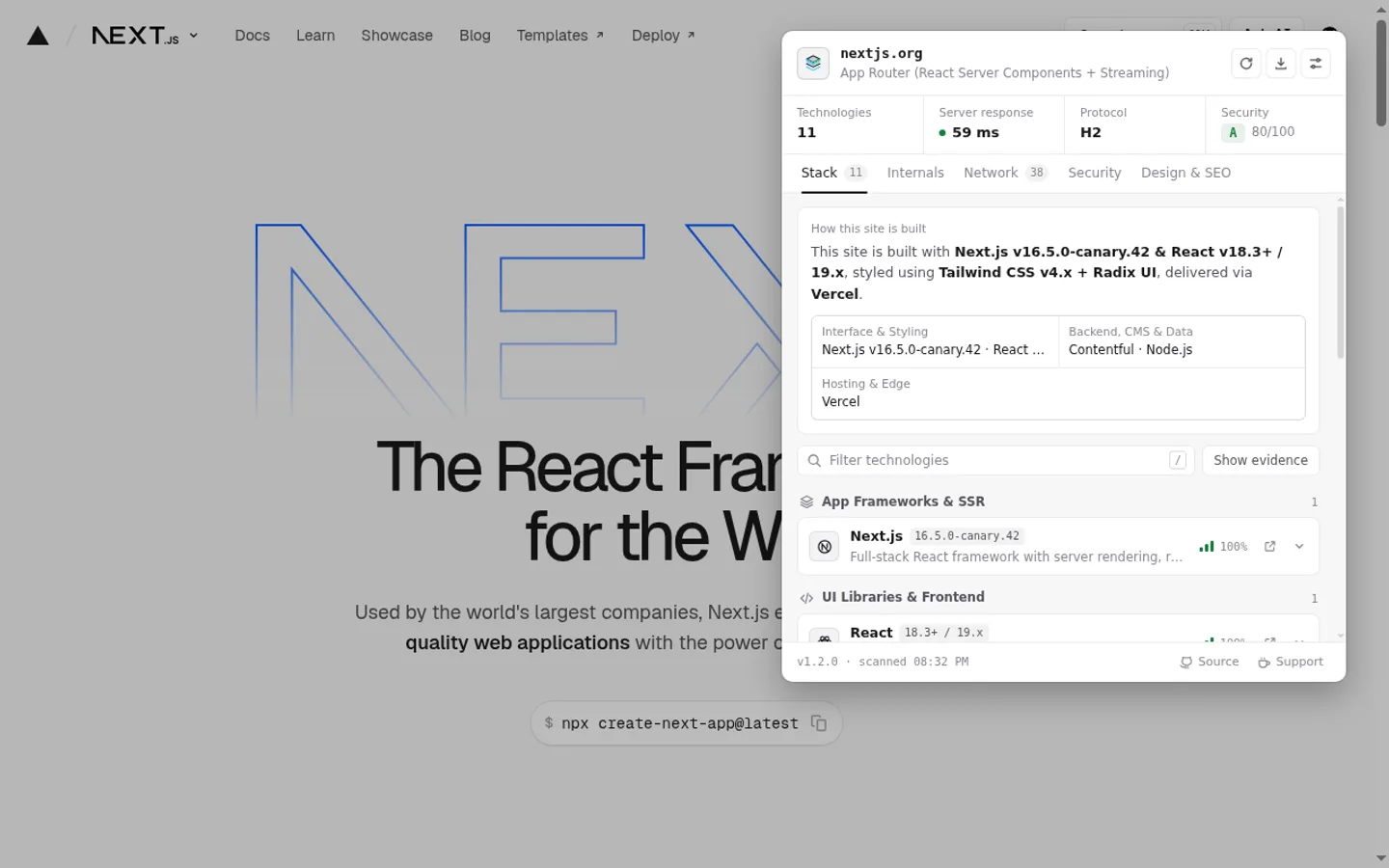
An extension for Chrome, Brave and Edge that shows what any website is built with, and the evidence for it.
- Client
- Open source
- Role
- Design, development
- Year
- 2026
The challenge
Most technology detectors give you a list of logos without saying how they got there. I wanted to see exactly what was found, so I could check it myself.
The solution
A toolbar popup with five tabs: stack, framework internals, network, security, and design & SEO. Each finding shows the script, header or page element it was matched on, with a confidence score.
How it was built
The technology at every layer, from the screen down to the infrastructure.
- Websites
- Manifest V3
- Popup UI
- Content scripts
- Apps
- Analysis engine
- Service worker
- About 200 signatures
- Hosting & cloud
- Optional DNS over HTTPS
- Networks & ITNot needed
Key technical decisions
Evidence, not logos
Every detected technology comes with the script, header, page element or global variable it was matched on.
Private by default
Only cookie names and security flags are read, never their values. The DNS lookup is opt-in and off by default.
No dependencies
Plain ES modules with no runtime libraries. Per-tab data lives in session storage, so nothing is lost when the service worker is suspended.
What it includes
- Technologies with version, confidence and evidence
- Rendering model: SSR, static, RSC, islands, SPA
- APIs, third-party domains and CSP analysis
- Security grade with ready-to-copy header fixes
- Report export as Markdown or JSON
The result
Open source on GitHub under the MIT licence, at version 1.2.0, with roughly 200 technology signatures. No servers, analytics or accounts.