I abandoned three prototypes before building Orama Suite.Why it wasn’t wasted time
The road behind Orama Suite: the prototypes I abandoned, the product I kept, and the testing discipline that keeps it stable.

In this article· 6 sections
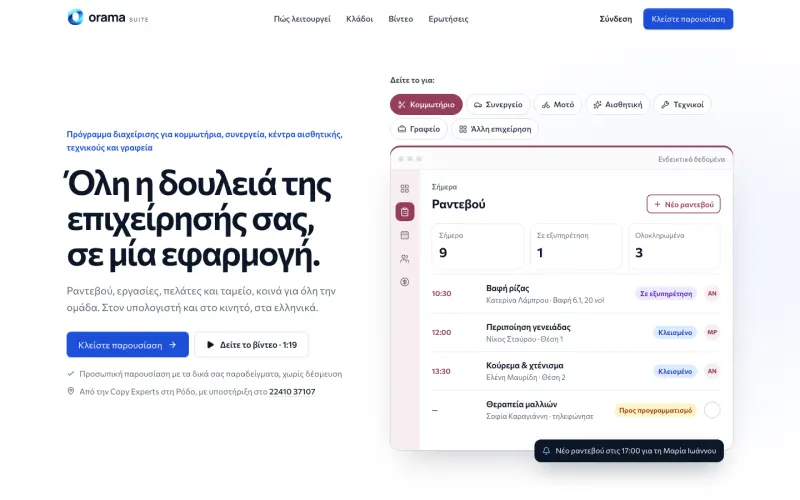
Orama Suite is now an appointment, task and customer app used by salons, garages, technicians and offices. It didn’t start that way. Before it, I built and threw away several versions of the same idea.
Appointments in a notebook, customers in a spreadsheet
Every small business I know has the same problem: appointments in a notebook, customers in a spreadsheet, cheques on sticky notes and contracts in the owner’s head. Off-the-shelf tools are expensive, English-only and built for other markets.
I wanted something simple, in Greek, that opens on a phone and understands how a Greek business works.
The prototypes I didn’t keep
The first attempt, in November 2025, was a small task app called TaskFlow, with PIN team sign-in and work logs. It was enough to show the idea made sense, not enough to hand to a customer.
The second was a fuller prototype on React and Supabase, with customers, contracts, a cash register and a price list. That’s where I learned how demanding the “small” details are. Printing labels on a thermal printer alone took dozens of fixes in a single day before it came out right.
I also tried Laravel, to see whether another framework would get me there faster. It didn’t.
The product I kept
In May 2026 I started again, with everything I had learned, on Cloudflare’s network: React for the interface, Hono for the API, a D1 database and file storage in R2. Within days it had customer ledgers, PDF export, a recycle bin and search that understands Greek without accents.
From there it grew around what real users needed. June brought support contracts and cheques, July brought repairs, with A5 tickets and thermal printing. In September I added templates for seven industries, an admin console and annual subscriptions, and the app got its own domain, oramasuite.gr. October added staff evaluations and PIN-locked notes.
Greeklish, tax IDs and a moving Easter
An app for Greek businesses has to understand Greece. Type “papadopoulos” or “παπαδοπουλος” and you find “Παπαδόπουλος”. A tax ID (ΑΦΜ) is checked against its check digit before a wrong one is saved. Deadlines know the holidays, including Greek Orthodox Easter, which moves every year.
And the time is Greek time everywhere. One bug made cash-register entries between midnight and 3 a.m. “disappear” from the day’s list, because they were counted in UTC. Now a day is counted the way the customer lives it.
Every change goes through the tests
When customers keep their business in an app, every mistake costs something. So the automated tests grew with the app:
| Date | Automated tests |
|---|---|
| 7 September 2026 | 351 |
| 22 September 2026 | 521 |
| 26 September 2026 | 1,094 unit and 153 end-to-end |
| 9 October 2026 | 1,283 unit and 156 end-to-end |
The end-to-end tests open a real browser, in Chrome and in Safari’s engine too, because many users open the app on an iPhone.
The same goes for the database: more than 70 schema changes, all additive, never deleting data. Before every release I take a backup and record a restore point.
Why the prototypes weren’t wasted
Every version I threw away taught me something I needed in the next one. Mostly, that the “small” details are the product: a thermal printer or a time-zone bug decides whether someone trusts the app. And the tests are what let me move fast without fearing every change.
To see whether Orama Suite fits your business, have a look at oramasuite.gr or send me a message. The first conversation is free.
Found it useful? Share it
Keep reading
- My app started slowing down. Why I didn’t switch databasesWhen the app slowed down, the temptation was to switch databases. The measurements said otherwise, and a Safari incident taught me how to ship releases safely.
- AI wrote your app. Do you know what it forgot to tell you?I checked 105 public AI-built apps and the code mostly looked fine. The real risk is what doesn’t show: six things AI won’t tell you before you launch.
The project behind this article
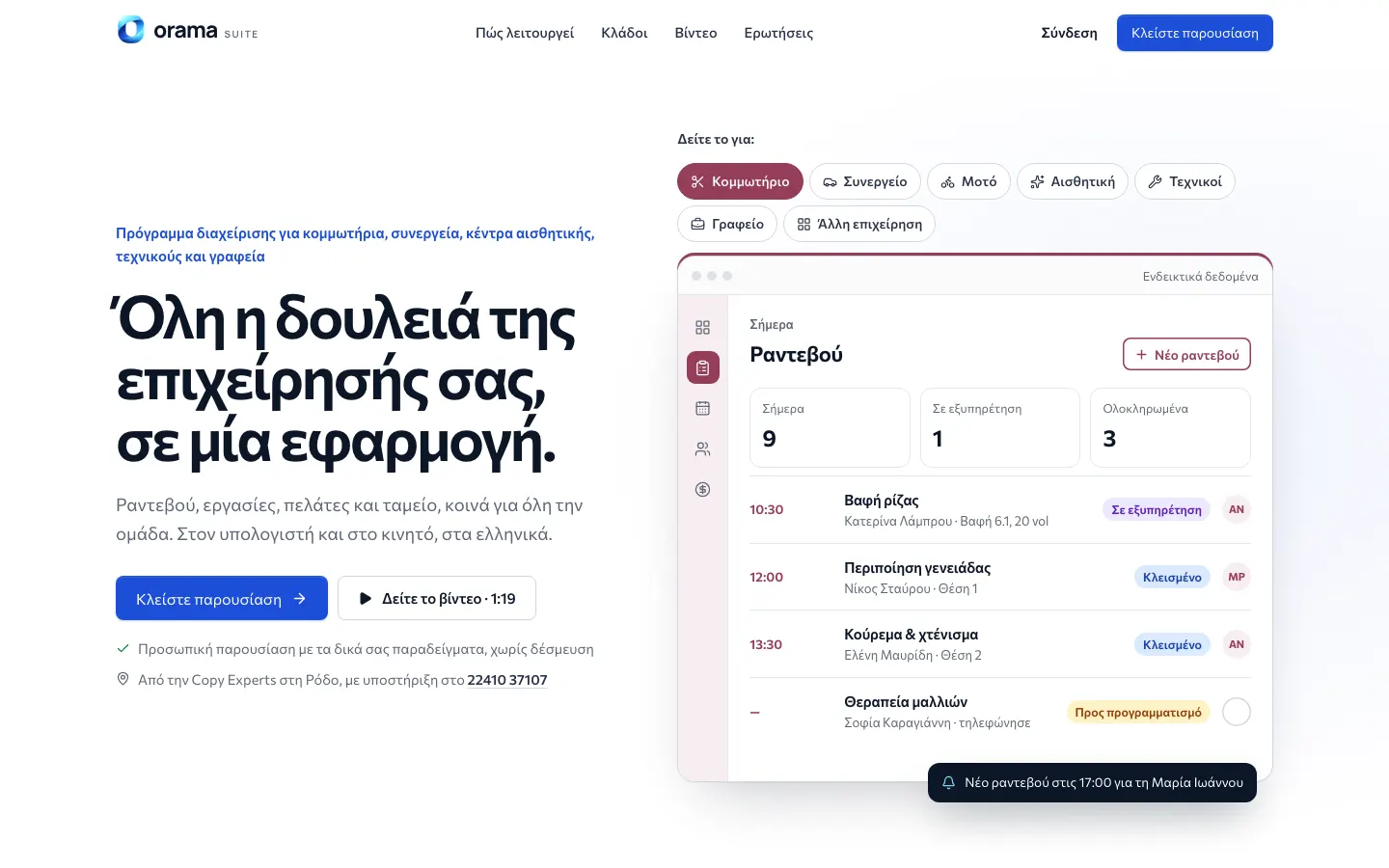
Appointments, tasks and customers in one app for small businesses — from salons to garages.